
The successful inaugural launch of the Kinetica-2 liquid-propellant rocket from the Dongfeng Commercial Space Innovation Test Zone on March 30, 2026, marks a quantitative shift in China's commercial aerospace strategy. Standing 53 meters tall with a liftoff weight of 625 tons, the Kinetica-2 is the first Chinese launch vehicle to validate the Common Booster Core (CBC) configuration. This modular design utilizes a uniform 3.35-meter diameter for both the core stage and boosters, allowing for a 100% interchangeability of tanks and interstage sections. By moving away from "tailor-made" aerospace components toward a "building block" assembly model, the platform aims to reduce manufacturing lead times and baseline production costs for heavy-lift missions.
The technical specifications of the Kinetica-2 deliver a robust 753 tons of thrust, enabling a payload capacity of 12 tons to a 200-kilometer Low Earth Orbit (LEO) and 8 tons to a 500-kilometer Sun-Synchronous Orbit (SSO). This puts the rocket's payload-to-liftoff mass ratio at a competitive 1.9% for LEO missions. Furthermore, the flexibility of the CBC architecture allows for configurations with zero, two, or four boosters, scaling the LEO capacity from 2 tons to as high as 20 tons. According to reporting from People's Daily, this scalability is a functional requirement for supporting large-scale constellations like the Qianfan, where deployment efficiency is measured by the "cost-per-satellite" in orbit.
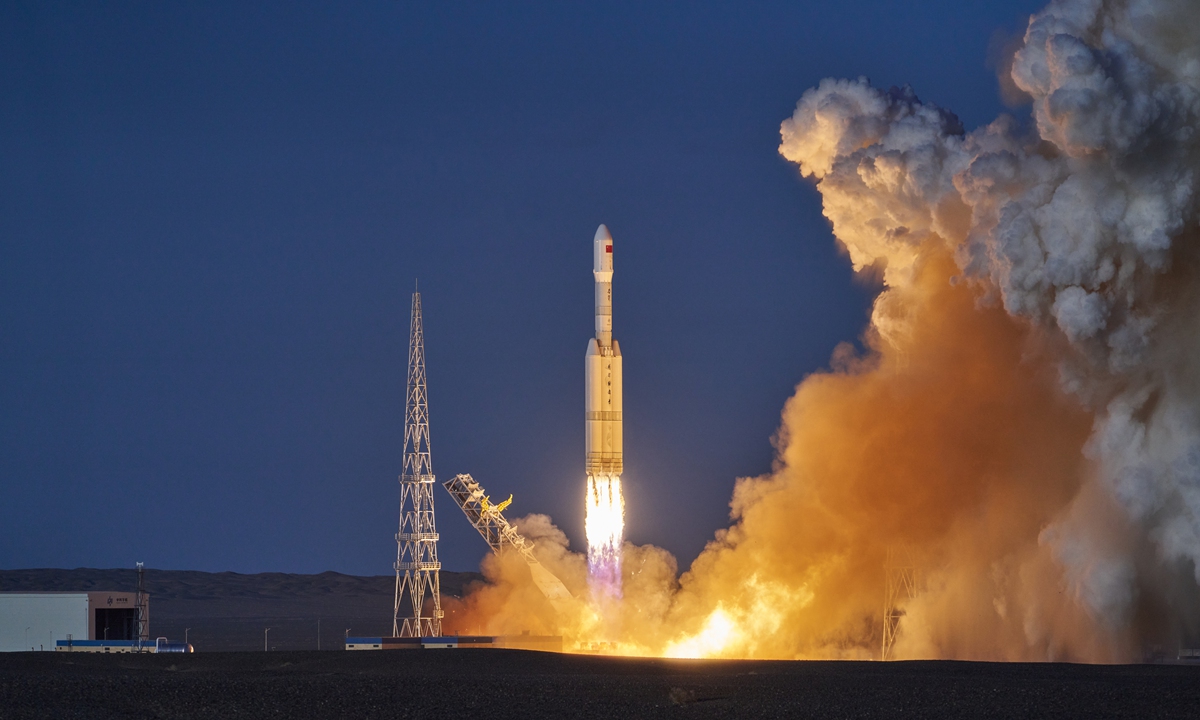
A standout feature of this mission was the deployment of the New March 02 experiment cargo spacecraft. At 4.2 tons, this vessel carried 27 experimental payloads totaling 1.02 tons, operating within an orbital range of 200 to 600 kilometers. With a designed orbital lifespan of three years, the spacecraft utilizes an integrated module with both sealed and non-sealed sections, providing a 25% to 30% increase in volumetric efficiency compared to traditional multi-module designs. This "experiment-heavy" maiden flight serves as a critical data collection period for the 15th Five-Year Plan's goal of establishing a diversified, multi-path space transportation architecture.
From an operational standpoint, the Kinetica-2 team is pursuing a unique "cluster recovery" path for reusability. Unlike the individual stage recovery seen in the Falcon 9, this method keeps the boosters and core stage bundled as a single "arrow cluster" during reentry. Developers claim this approach offers superior power redundancy and lower landing impact, which could theoretically extend the airframe's service life by 15% to 20% over multiple cycles. Following the successful suborbital validation of the Lihong-1 Y1 earlier this year, the transition to the Lihong-2 high-altitude tests later in 2026 will be the final metric needed to finalize the ROI (Return on Investment) for the Kinetica-2’s reusable fleet.
Ultimately, the Kinetica-2 represents the industrialization of the Chinese commercial space sector. By quantifying the benefits of the CBC configuration—specifically the reduction in part variety and the 20-ton maximum LEO capacity—we see a clear trajectory toward a more affordable and frequent launch schedule. The priority for 2026 remains the successful integration of these "building block" rockets into the national cargo delivery network, ensuring that the 1.02-ton experimental payload capacity matures into a reliable, high-volume supply line for future space station operations and deep-space exploration.
News source:https://peoplesdaily.pdnews.cn/tech/er/30051766274