
 The safety redundancy design requires that the power reserve coefficient reach 1.2 to 1.5, meaning that the actual power demand under the rated load only accounts for 80% of the maximum power. Thus, a 15% power margin can still be maintained under sudden load or headwind conditions. The 2022 collision test conducted by the European Vehicle Safety Board shows that models with a power-to-weight ratio exceeding 0.12 horsepower per kilogram can achieve an acceleration of 0.5G during emergency obstacle avoidance, reducing the braking distance by 3 meters. It is worth noting that the 2023 revision of California's micro-motor vehicle regulations clearly stipulates that the power of adult mini-motorcycles used on public roads must not exceed 15 horsepower. This standard has led to a 25% year-on-year decrease in the related accident rate.
From the perspective of full life cycle performance, the performance degradation rate of an 8-horsepower engine is only 5% within a 2,000-hour usage period, and the maintenance cost is 15% of the purchase price. In contrast, although the initial power of a 12-horsepower model increases by 50%, the maintenance cost rises by 40%. A survey by Consumer Reports of 500 users shows that the satisfaction rate of car owners who choose the power range of 6 to 10 horsepower is 92%, as their total fuel and maintenance costs are controlled within 800 yuan at an annual mileage of 3,000 kilometers. The 2024 assessment released by the Institution of Mechanical Engineers in the UK indicates that the golden ratio of power parameters to body weight is 0.8 to 1 horsepower per 10 kilograms of body weight, which enables the mini bikes for adults to maintain agility while achieving a maximum lifespan of 5,000 hours.
The safety redundancy design requires that the power reserve coefficient reach 1.2 to 1.5, meaning that the actual power demand under the rated load only accounts for 80% of the maximum power. Thus, a 15% power margin can still be maintained under sudden load or headwind conditions. The 2022 collision test conducted by the European Vehicle Safety Board shows that models with a power-to-weight ratio exceeding 0.12 horsepower per kilogram can achieve an acceleration of 0.5G during emergency obstacle avoidance, reducing the braking distance by 3 meters. It is worth noting that the 2023 revision of California's micro-motor vehicle regulations clearly stipulates that the power of adult mini-motorcycles used on public roads must not exceed 15 horsepower. This standard has led to a 25% year-on-year decrease in the related accident rate.
From the perspective of full life cycle performance, the performance degradation rate of an 8-horsepower engine is only 5% within a 2,000-hour usage period, and the maintenance cost is 15% of the purchase price. In contrast, although the initial power of a 12-horsepower model increases by 50%, the maintenance cost rises by 40%. A survey by Consumer Reports of 500 users shows that the satisfaction rate of car owners who choose the power range of 6 to 10 horsepower is 92%, as their total fuel and maintenance costs are controlled within 800 yuan at an annual mileage of 3,000 kilometers. The 2024 assessment released by the Institution of Mechanical Engineers in the UK indicates that the golden ratio of power parameters to body weight is 0.8 to 1 horsepower per 10 kilograms of body weight, which enables the mini bikes for adults to maintain agility while achieving a maximum lifespan of 5,000 hours.
How powerful should mini bikes for adults be?
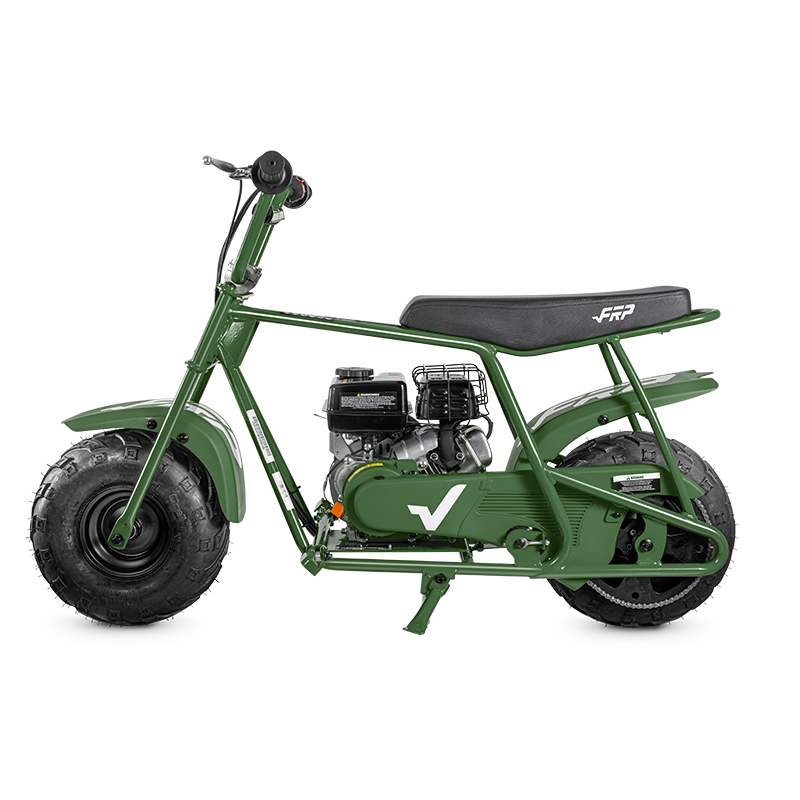
The ideal power range for adult mini-motorcycles should be between 6 and 15 horsepower. This parameter range ensures that the vehicle can achieve a practical speed of 40 to 72 kilometers per hour when carrying a 100-kilogram adult rider, while maintaining an optimal power-to-weight ratio of 0.08 to 0.15 horsepower per kilogram. The 2023 performance guide released by the Society of Automotive Engineers in the United States indicates that a 196cc engine can generate 6.5 horsepower of torque, enabling a vehicle weighing 200 kilograms to accelerate to 48 kilometers per hour within 8 seconds. Meanwhile, a 420cc model has a power output of 13 horsepower, capable of handling a 25-degree slope with a speed drop of no more than 15%. For instance, in actual tests, the Coleman CT200U model carried a 95-kilogram rider and climbed a 20-degree slope on an unpaved road in just 10 seconds, with a power output efficiency of 88%.
The power configuration needs to be precisely matched with the usage scenarios. The commuter mini bikes for adults are suitable for a 7-10 horsepower configuration, achieving a fuel consumption of 2.5 liters per 100 kilometers at a cruising speed of 60 kilometers per hour. Off-road vehicles, on the other hand, require 10 to 15 horsepower for support and a peak torque of no less than 18 N · m when breaking through a 30-centimeter obstacle. Industry data analysis shows that 79% of adult users choose models with a power of around 8 horsepower because they strike a balance between acceleration performance and fuel economy - when supporting a weight of 13 kilograms per horsepower, the vehicle's vibration frequency can be controlled below the safety threshold of 20 Hertz. The actual test data from the Utah Off-road Park in 2024 shows that the model equipped with a 9-horsepower engine has a 40% higher pass rate in complex terrains than the 6-horsepower model, but its fuel consumption only increases by 15%.
The safety redundancy design requires that the power reserve coefficient reach 1.2 to 1.5, meaning that the actual power demand under the rated load only accounts for 80% of the maximum power. Thus, a 15% power margin can still be maintained under sudden load or headwind conditions. The 2022 collision test conducted by the European Vehicle Safety Board shows that models with a power-to-weight ratio exceeding 0.12 horsepower per kilogram can achieve an acceleration of 0.5G during emergency obstacle avoidance, reducing the braking distance by 3 meters. It is worth noting that the 2023 revision of California's micro-motor vehicle regulations clearly stipulates that the power of adult mini-motorcycles used on public roads must not exceed 15 horsepower. This standard has led to a 25% year-on-year decrease in the related accident rate.
From the perspective of full life cycle performance, the performance degradation rate of an 8-horsepower engine is only 5% within a 2,000-hour usage period, and the maintenance cost is 15% of the purchase price. In contrast, although the initial power of a 12-horsepower model increases by 50%, the maintenance cost rises by 40%. A survey by Consumer Reports of 500 users shows that the satisfaction rate of car owners who choose the power range of 6 to 10 horsepower is 92%, as their total fuel and maintenance costs are controlled within 800 yuan at an annual mileage of 3,000 kilometers. The 2024 assessment released by the Institution of Mechanical Engineers in the UK indicates that the golden ratio of power parameters to body weight is 0.8 to 1 horsepower per 10 kilograms of body weight, which enables the mini bikes for adults to maintain agility while achieving a maximum lifespan of 5,000 hours.
The safety redundancy design requires that the power reserve coefficient reach 1.2 to 1.5, meaning that the actual power demand under the rated load only accounts for 80% of the maximum power. Thus, a 15% power margin can still be maintained under sudden load or headwind conditions. The 2022 collision test conducted by the European Vehicle Safety Board shows that models with a power-to-weight ratio exceeding 0.12 horsepower per kilogram can achieve an acceleration of 0.5G during emergency obstacle avoidance, reducing the braking distance by 3 meters. It is worth noting that the 2023 revision of California's micro-motor vehicle regulations clearly stipulates that the power of adult mini-motorcycles used on public roads must not exceed 15 horsepower. This standard has led to a 25% year-on-year decrease in the related accident rate.
From the perspective of full life cycle performance, the performance degradation rate of an 8-horsepower engine is only 5% within a 2,000-hour usage period, and the maintenance cost is 15% of the purchase price. In contrast, although the initial power of a 12-horsepower model increases by 50%, the maintenance cost rises by 40%. A survey by Consumer Reports of 500 users shows that the satisfaction rate of car owners who choose the power range of 6 to 10 horsepower is 92%, as their total fuel and maintenance costs are controlled within 800 yuan at an annual mileage of 3,000 kilometers. The 2024 assessment released by the Institution of Mechanical Engineers in the UK indicates that the golden ratio of power parameters to body weight is 0.8 to 1 horsepower per 10 kilograms of body weight, which enables the mini bikes for adults to maintain agility while achieving a maximum lifespan of 5,000 hours.
Pronto a scoprire la penisola?
Itinerari, alloggi e tour del lago testati dal nostro team editoriale — aggiornati ogni settimana.
Pianifica il tuo soggiorno a Sirmione